I wondered if...
can a small set of mechanics produce a mobile rogue-like game that is simple, fair and difficult to put down?
A mobile game experiment focused on pacing, replayability and the uncomfortable discovery that balancing a simple game is not simple at all.
The Question
This one started with Balatro and CloverPit.
Both games do something I find fascinating: they take a tiny set of rules, add a deck of modifiers that bend those rules, and produce runs that feel different every time. Neither game has a story, a world or much of an interface. What they have is a loop you can hold in your head and a build system that keeps surprising you.
I wondered if I took those rogue-like mechanics and gave them a vibe coding theme — absurd software contracts, burning ridiculous quantities of AI tokens, increasingly unstable compute infrastructure — would it make a decent mobile game?
Turns out it's not bad.
The Problem
Most of my side projects grow until they stop being fun. I wondered whether the opposite constraint would work: pick the smallest possible set of mechanics and see how far they stretch before players get bored.
Games like Balatro succeed because every run is a sequence of small, legible decisions with consequences you can reason about. That sounds easy to copy. It isn't, because the real work is invisible: the economy has to be tuned so that clever builds feel powerful without any single strategy dominating, and the rules have to survive whatever combination the player throws at them.
The theme gave me a second problem I didn't anticipate. If the joke is "burn absurd quantities of tokens", the numbers have to escalate from millions to quadrillions over a single run — and an economy that spans nine orders of magnitude is genuinely hard to keep fair at both ends.
The Hypothesis
My starting hypothesis was that a run-based game needs surprisingly little: contracts to complete, one currency for actions, a board where placement matters and a pile of rule-bending modifiers. Everything else — theme, escalation, meta-progression — could be data rather than code.
That led to a design principle I wrote down early and kept coming back to:
Strong combinations should be allowed to break the economy. Invalid combinations must never break the simulation.
If a player finds a perk combination that prints money, that's a balancing note, not a
bug. If a perk combination crashes the game or produces NaN cash, that's a failure of
engineering. Keeping those two categories separate shaped most of the architecture.
The Approach
I built it in Godot 4 with GDScript, portrait-first for mobile, exporting to Android.
You play a reckless vibe coder. A run is twelve rounds of the same loop: accept software contracts from a job board, buy hardware and cloud upgrades on the market, and arrange pipeline modules — prompts, cheap models, agent swarms, token caches, unit tests — into workflows on the Burn Board. Then you spend prompts. Each burn pushes a batch of tokens through your pipeline, making progress on contracts while generating heat, bugs and bills. Or you can cool, spending the prompt to vent heat instead of working.
Contracts start at a plausible twelve million tokens for product descriptions and escalate to 1.4 trillion for an authentication system, because of course they do. The run doesn't really end at survival: from round four you can qualify for Ascension Contracts, endgame jobs that start at twenty billion tokens and climb into exatokens.
The Balatro DNA is in the perks: twenty-four rule-benders with names like Ship It, Works On My Machine, Technical Debt, Rubber Duck and Vibe Check, drafted for free from angel investors between rounds. Position on the board matters too — a token cache placed before a model discounts it; the same cache in the last slot banks quality instead. Certain pairs form named synergies. My favourite is Vibe Coding: Vibe Check plus Bug Alchemy, which is roughly "ship on feel and transmute the consequences".
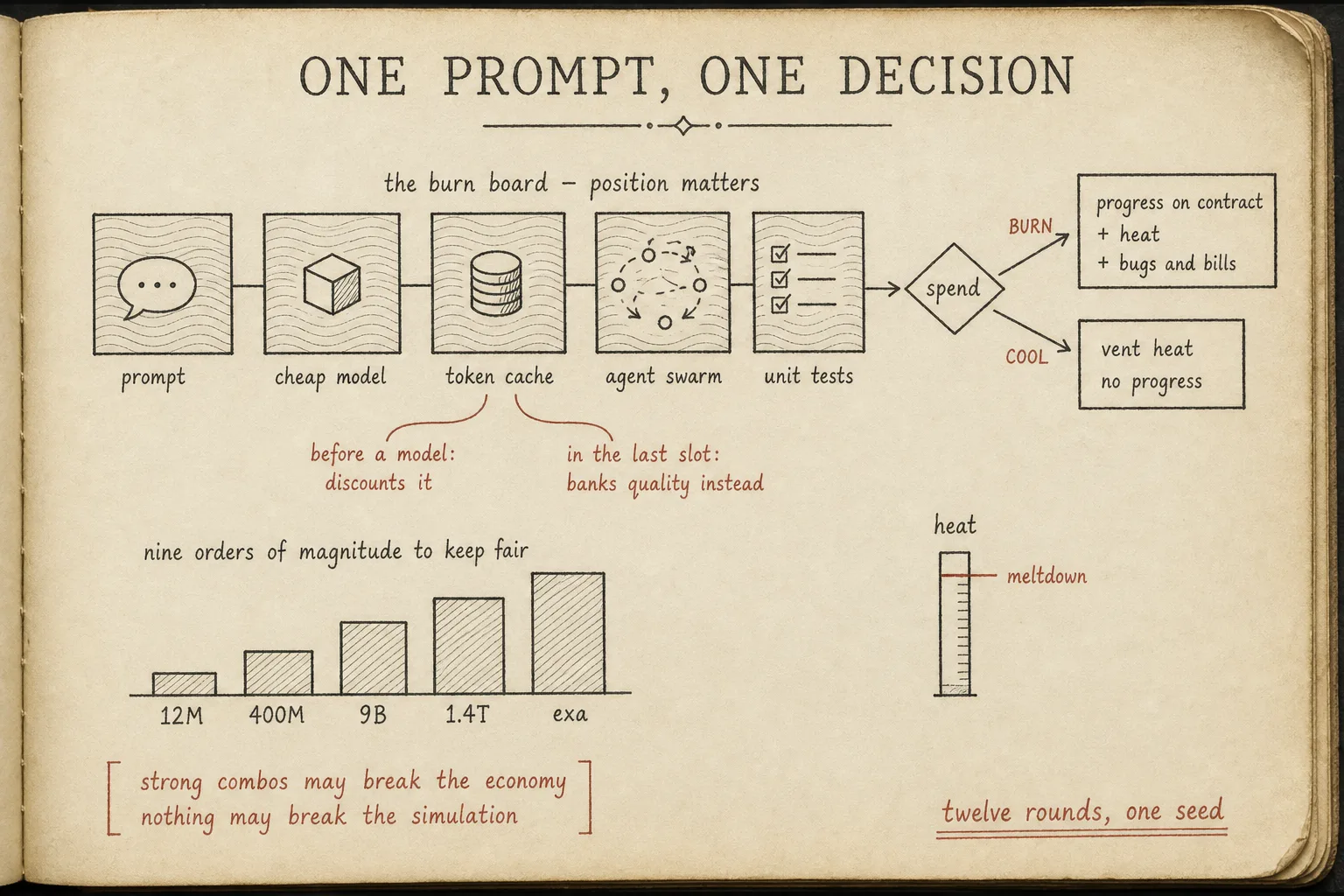
Every prompt is one decision with a visible consequence. The bar chart is the part that made balancing an engineering problem rather than a matter of taste.
Architecture
The simulation is authoritative and the UI is an observer. All game rules live in a simulation layer that the interface can only send actions to — accept this job, burn a batch, buy this upgrade. The UI never computes an outcome itself, which means the whole game can run headless, and that turned out to be the most important decision in the project.
Almost everything is data. Jobs, perks, upgrades, events and pipeline operations are JSON definitions that declare event subscriptions and effects using a small vocabulary — add, multiply, convert, spawn, defer a cost, borrow. An effect resolver applies them in fixed phases (base, additive, multiplicative, conversion, caps, triggers, finalise) so that stacking order is deterministic rather than an accident of load order.
The "never break the simulation" half of the design principle is enforced by a chain guard: effect chains are capped at a depth of 32, ten thousand effects per action and 256 spawns, so a degenerate combination fizzles instead of hanging the game.
Randomness is a custom deterministic generator with named substreams — the job board, the perk draft and the event roll each draw from their own stream derived from the run seed. A given seed always produces the same run, which makes bugs reproducible and automated balancing possible.
There's a self-referential footnote to the architecture: the repository is organised so that multiple AI coding agents could work on it in parallel — per-folder code ownership, ADRs locking the shared contracts before content work started. The game about burning tokens was itself built by burning a frankly thematic quantity of tokens.
Trade-offs
- Interactive burns over an idle loop. The original design had production ticking along continuously, month by month. It simulated fine and played terribly, so the loop was rebuilt around deliberate, one-at-a-time prompt spends. The old automatic loop survives behind a feature flag because the balancing tools still drive runs with it.
- A data-driven effect engine over bespoke perk code. Twenty-four perks as JSON means new content without new code, but it also means the effect vocabulary is a hard contract. Early on the semantics were half-stubbed and everything downstream stalled until I stopped and specified them properly in an ADR.
- Determinism over convenience. Seeded substreams cost discipline — every system has to draw from the right stream, and UI code must never touch one. What it buys is reproducible bugs and trustworthy batch simulation, which the balancing work would have been impossible without.
- Android only, for now. One export preset, arm64, no iOS. Shipping one platform's quirks was enough while the design was still moving.
What Went Wrong
The first version of the core loop was boring, and I didn't want to admit it. Production
ran continuously while you watched numbers climb — an idle game wearing a rogue-like's
clothes. The simulation was elegant and there was nothing to do. Rebuilding the loop
around discrete prompt spends, where every burn is a choice between progress and heat,
was the single largest rework in the project. The calendar went with it: runs were
originally framed as twelve months, and the month-to-round rename still shows in save
migrations and a bills screen stubbornly called month_statement.
Balancing by intuition failed almost immediately. With numbers spanning millions to quadrillions, I couldn't feel whether a perk was overpowered by playing — I'd tune one tier and quietly wreck another. The fix was to stop playtesting by hand and build tooling: a batch runner that plays up to a thousand headless runs against simple policies, a combo scanner that simulates perk pairs and flags anything with a win rate above 95% or a token rate over a billion, and an in-game Burn Lab with tuning sliders and effect traces. The balancing tools ended up being some of the most interesting engineering in the repository, which is not what I expected from a silly mobile game.
Determinism was harder to keep than to design. The job board originally rerolled its offers every time the UI refreshed, which meant tapping around the interface advanced the game's random streams — offers had to be stamped once per round instead. Multiplying the token rate during perk events corrupted the stacking maths until rate changes became registered modifiers applied on recalculation rather than direct mutations.
Smaller indignities are preserved in a regression suite: an upgrade that could be bought twice and drain your cash, the headless test runner autosaving over real player saves, and a UI designed at 1080 pixels wide that was unreadable on an actual phone. The save format is on version eight, which is its own kind of confession.
Lessons
- Balancing is an engineering problem wearing a design costume. I assumed tuning would be taste and playtesting. At this numeric scale it was simulation, statistics and tooling, and the game only became fair once I could run a thousand automated runs and look at the distribution.
- Separate "breaks the economy" from "breaks the simulation". Letting strong builds be broken is what makes a rogue-like joyful; guard rails belong around correctness, not power. The chain guard meant I could add absurd content without fearing crashes.
- An authoritative, headless simulation pays for itself. Every good thing in this project — batch balancing, combo scanning, reproducible bugs, regression tests for real failures — came from the UI never owning a rule.
- Data-driven content needs its semantics locked first. Definitions in JSON are only fast to author once the effect vocabulary is specified and stable. Stubbed semantics blocked everything built on top of them.
- The loop is the game. A correct, elegant simulation with nothing to decide is a spreadsheet. The project only started being fun when every prompt spend became a choice with a visible consequence.
Current State
Token Burn is a playable vertical slice, not a released game. A full twelve-round run works end to end on Android: contracts, the Burn Board, perks, upgrades, random events, angel drafts, ascension contracts, save and load, meta-progression and achievements. The headless test runner, batch simulator and combo scanner keep the balance honest, and an APK exists at version 0.4.0.
What doesn't exist yet is evidence from other people. I know the loop holds my attention; whether it is genuinely difficult to put down is exactly the kind of claim that needs playtesters rather than my own enthusiasm. The repository is private, but I'm happy to walk through the simulation and the balancing tools.
Next Questions
- Does the loop survive contact with players who don't already find the theme funny?
- Is ascension the right ending, or does a run need a sharper final decision?
- Two perks from the original design never made it into content. Do they earn their place, or was cutting them the right call?
- What does an iOS export cost beyond the Android preset?
- How much of the balancing tooling generalises? A combo scanner that hunts degenerate strategies feels useful well beyond this game.